
For decades, industrial maintenance teams have relied on scheduled inspections, oil sampling and periodic equipment servicing to keep machinery operating reliably. These methods remain valuable, but modern manufacturing is increasingly moving towards a different question:
What if equipment could continuously report changes in its own condition?
That is where real-time oil condition monitoring, Industrial Internet of Things (IIoT) technology and artificial intelligence are changing the way industrial lubrication is managed.
Oil is not simply a lubricant. As it circulates through a machine, it can provide information about contamination, degradation and changes occurring inside the equipment. Traditional oil analysis can already use this information to identify potential problems. Real-time monitoring takes the concept further by continuously collecting oil-condition data and delivering it remotely.
Mobil’s current Mobil Serv Real Time and Mobil Serv IIoT Insights technologies demonstrate this transition, combining continuous oil monitoring, live data, alerts, trend analysis and AI/ML-supported insights to help maintenance teams move from preventive towards predictive maintenance.
But can real-time oil monitoring actually predict equipment failure?
The answer requires a little nuance.
It does not mean that a system can always provide an exact date and time when a machine will fail. Rather, it can identify changes in lubricant and equipment condition early enough to help maintenance teams investigate developing problems and take corrective action before they become major failures.
From Lubricant to Source of Equipment Intelligence
Industrial lubricant performs several essential functions:
- Reducing friction
- Controlling wear
- Carrying heat away from components
- Protecting against corrosion
- Supporting smooth operation
- Preventing direct metal-to-metal contact
But oil also interacts continuously with the equipment.
During operation, it can be affected by:
- Wear particles
- Contamination
- Water or humidity
- Oxidation
- Temperature
- Mechanical stress
- Changes in operating conditions
This means the condition of the oil can provide clues about what is happening inside the machine.
Mobil describes lubricant analysis as a tool for understanding both lubricant and equipment performance, with oil testing helping identify potential equipment problems and contamination before they result in excessive wear or failure.
The evolution towards real-time monitoring essentially changes the model from:
Take sample → Send to laboratory → Receive report → Take action
to:
Continuously monitor → Detect change → Analyse trend → Alert → Investigate → Act
That difference can be significant for critical industrial assets.
What Is Real-Time Oil Condition Monitoring?
Traditional oil analysis usually involves periodically collecting an oil sample and sending it for testing.
Real-time monitoring uses sensors and connected systems to continuously or frequently capture information about oil and equipment condition.
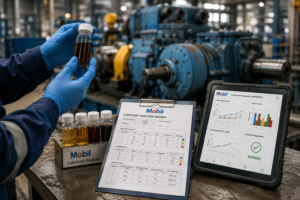
Mobil Serv Real Time is designed to provide remote access to oil diagnostics through a live dashboard, continuously monitor multiple parameters and generate alerts when potential issues are detected.
A simplified architecture looks like this:
Machine → Oil Sensor → Data Collection → Cloud Platform → Analytics / AI & ML → Trend or Anomaly Detection → Maintenance Insight → Corrective Action
This is where IIoT becomes important.
The sensor is not operating as an isolated measurement device. It becomes part of a connected information system that allows equipment data to be accessed and analysed remotely.
What Can Oil Monitoring Actually Tell You?
The specific parameters available depend on the monitoring system and application, but oil condition monitoring can provide information about several important aspects of machine health.
Mobil’s IIoT Insights platform, for example, provides real-time oil-condition information including NAS value and humidity, alongside process and machine information such as OEE, production details and power consumption.
Oil analysis programmes can also examine parameters such as:
- Viscosity
- Water contamination
- Wear metals
- Contaminants
- Oxidation
- Particle levels
- Lubricant degradation
Mobil’s oil-analysis resources explain that changes in viscosity, wear metals and contamination can provide useful information about lubricant and equipment condition.
This creates an important principle:
The value is not in one isolated measurement. The value is in understanding how the measurement changes over time.
Why Trends Are More Valuable Than a Single Reading
Imagine a hydraulic system where the oil condition is normal today.
A single reading tells maintenance personnel what the machine looks like today.
Now imagine that the same parameter is measured repeatedly:
Day 1 → Day 7 → Day 14 → Day 21 → Day 28
If the values remain stable, the system is showing one type of behaviour.
If they gradually move away from the normal operating range, that trend may warrant investigation.
Mobil’s Real Time technology specifically uses data trends to help plan servicing and optimise oil drain intervals, while its IIoT Insights platform uses trend analysis across live and historical data to support corrective actions.
This is one of the fundamental differences between monitoring and predictive maintenance.
Predictive maintenance depends on understanding how equipment condition is changing – not simply knowing its current state.
Where AI and Machine Learning Enter the Picture
Continuous monitoring creates a new challenge:
More data does not automatically mean better maintenance.
A modern factory can have numerous machines and potentially thousands of data points.
Manually reviewing every parameter and every trend can quickly become impractical.
AI and machine learning can help by analysing large volumes of historical and live data to identify patterns.
Mobil describes its Real Time solution as combining AI and machine learning with historical data to generate actionable insights and recommendations. Its IIoT Insights platform similarly describes AI recommendations and AI/ML-driven analysis as part of its predictive-maintenance approach.
The basic concept is:
Data collection → Historical baseline → Pattern recognition → Deviation detection → Risk indication → Maintenance recommendation
This does not eliminate the need for engineers.
Instead, it helps maintenance teams focus their attention on the assets and conditions that require investigation.
Can AI Actually Predict Equipment Failure?
This is where the distinction between failure prediction and early detection becomes important.
A monitoring system cannot guarantee that it will know the exact moment a gearbox, hydraulic pump or bearing will fail.
Equipment behaviour is affected by many variables, and unexpected events can occur.
However, real-time monitoring can help identify conditions associated with developing problems.
For example:
Contamination increases → Lubricant condition changes → Component protection may deteriorate → Wear risk increases → Monitoring system identifies an abnormal trend → Maintenance team investigates
The system has not necessarily “predicted the exact failure.”
It has identified a developing condition early enough to potentially prevent the situation from progressing.
That distinction is important when discussing predictive maintenance realistically.
Real-Time Monitoring vs Traditional Oil Analysis
Traditional oil analysis remains highly useful.
In fact, real-time monitoring does not necessarily replace laboratory analysis.
The two approaches can complement each other.
| Traditional Oil Analysis | Real-Time Monitoring |
| Periodic sampling | Continuous/frequent monitoring |
| Laboratory-based testing | Connected sensor-based data |
| Detailed analytical reports | Live data and alerts |
| Snapshot of condition | Continuous trend |
| Scheduled sampling | Remote monitoring |
| Specialist interpretation | Automated analytics + expert review |
| Useful for deeper analysis | Useful for rapid detection |
Mobil itself describes oil analysis as an important condition-monitoring tool and notes that other practices such as inspections, vibration monitoring and operator logs can further enhance an overall equipment-reliability programme.
This suggests that the most effective maintenance strategy is not necessarily oil monitoring instead of everything else.
It is:
Oil monitoring + vibration + inspections + operating data + engineering expertise
How Real-Time Monitoring Can Help Detect Hydraulic-System Problems
Hydraulic systems are particularly interesting for real-time oil monitoring because lubricant condition directly affects pumps, valves and other critical components.
Mobil’s IIoT Insights platform specifically describes monitoring oil health and using the resulting insights to help optimise oil and filter life and avert pump and valve failures.
Potential warning indicators can include:
- Contamination
- Water or humidity
- Changes in oil condition
- Abnormal temperature
- Changes in machine cycle behaviour
- Other deviations from established operating patterns
For a manufacturing plant, early identification can allow maintenance teams to investigate the hydraulic system before a developing issue becomes a major production interruption.
How It Can Help With Gearboxes
Industrial gearboxes operate under combinations of:
- High loads
- Sliding and rolling contact
- Temperature
- Shock loading
- Continuous operation
Lubricant condition is therefore important to gearbox reliability.
Oil monitoring can help maintenance teams identify changes associated with:
- Wear
- Contamination
- Lubricant degradation
- Abnormal operating conditions
Mobil already provides gearbox-specific lubricant analysis as part of its broader equipment-monitoring services.
For critical gearboxes, combining oil-condition information with vibration and temperature monitoring can provide a broader picture of equipment health.
The Importance of Combining Oil Data With Machine Data
One of the biggest developments in IIoT-based lubrication is that oil information does not have to remain isolated.
Mobil Serv IIoT Insights can combine oil-health information with process and production information, including machine OEE, production details and power consumption.
This opens the possibility of asking more useful questions.
Instead of:
“Has the oil changed?”
maintenance teams can ask:
“Did the oil condition change at the same time as machine temperature, production behaviour or power consumption?”
That additional context can make an abnormal reading easier to investigate.
From Alarm to Action
An alert by itself does not improve equipment reliability.
The maintenance process after the alert is just as important.
A practical workflow could look like:
1. Detect
The monitoring system identifies an abnormal change.
2. Validate
Maintenance personnel check whether the change is genuine and relevant.
3. Diagnose
The team investigates potential causes.
4. Plan
If intervention is required, maintenance can be scheduled based on equipment criticality and production requirements.
5. Correct
The underlying problem is addressed.
6. Verify
The machine is monitored again to determine whether the condition has stabilised.
This creates a continuous improvement loop:
Monitor → Detect → Diagnose → Act → Verify → Learn
AI and IIoT can make the monitoring and detection stages more scalable, but engineering expertise remains essential for diagnosis and corrective action.
Real-Time Monitoring Can Also Change Oil-Drain Decisions
One common approach in industrial lubrication is to change oil according to a fixed calendar or operating-hour interval.
But oil condition does not necessarily deteriorate at exactly the same rate in every application.
Operating temperature, contamination, load, machine condition and duty cycle can all influence lubricant life.
Mobil Serv Real Time is specifically designed to build oil-condition trends that can support more informed oil-drain interval decisions.
This creates the possibility of moving from:
“Change oil every X hours.”
towards:
“Change oil when condition data indicates that intervention is required, within the manufacturer’s and lubricant’s applicable limits.”
The objective is not simply to extend drain intervals.
It is to make the interval condition-informed.
Any extension should still be supported by appropriate technical analysis and equipment/lubricant requirements.
Why This Matters for Mobil Industrial Lubricants
Real-time monitoring does not make lubricant quality irrelevant.
In fact, the opposite is true.
The lubricant becomes part of a broader asset-management strategy.
Mobil’s industrial lubricants are developed for applications including gears, hydraulics, bearings, compressors and other industrial equipment, with formulations designed for different loads, temperatures, environments and operating requirements.
The combination can therefore be viewed as:
- Right Mobil lubricant
- Correct lubrication practice
- Continuous condition monitoring
- Data analysis
Maintenance action
This approach connects the physical lubricant with digital maintenance intelligence.
The Role of Mobil Lubricant Analysis
Real-time monitoring is not the only way Mobil uses lubricant data.
Mobil Lubricant Analysis provides laboratory-based testing of oil samples and produces information about lubricant and equipment condition. Mobil says its programme can help identify deviations from normal conditions and support decisions around equipment management and lubricant performance.
This creates two complementary approaches:
Real-time monitoring
Useful for:
- Continuous observation
- Rapid alerts
- Live trends
- Remote access
- Early warnings
Laboratory oil analysis
Useful for:
- Detailed sample testing
- Deeper lubricant assessment
- Wear-metal analysis
- Contamination analysis
- Confirming developing conditions
The two can work together within a broader predictive-maintenance programme.
What a Modern Industrial Lubrication Strategy Could Look Like
The future of industrial lubrication is unlikely to be simply about choosing a better oil.
It is increasingly about connecting lubricant + equipment + data + maintenance expertise.
A modern strategy can be represented as:
Equipment
Understand the machine and its operating requirements.
Lubricant
Select the appropriate Mobil Industrial Lubricants product.
Monitoring
Track oil and equipment condition.
Connectivity
Transfer data through IIoT infrastructure.
Analytics
Analyse current and historical trends.
AI/ML
Identify patterns and potential abnormalities.
Maintenance
Investigate and intervene based on condition.
Learning
Use historical information to improve future maintenance decisions.
This is the fundamental change taking place in industrial lubrication.
Challenges to Consider Before Implementing Real-Time Oil Monitoring
Despite its potential, real-time monitoring is not a magic solution.
Companies should consider:
Sensor suitability
The sensor and monitoring technology must be appropriate for the specific equipment and application.
Data quality
Poor installation, inappropriate measurement points or unreliable data can compromise the value of analytics.
Baseline establishment
AI-driven insights are more meaningful when the system has sufficient information about normal operating behaviour.
Integration
The monitoring platform should fit into existing maintenance and plant-management workflows.
Human expertise
Alerts still need engineering interpretation and appropriate corrective action.
Cost-benefit analysis
Not every machine needs continuous monitoring. Critical assets generally offer a stronger case for advanced monitoring than low-value, non-critical equipment.
A practical approach is therefore to start with equipment where unexpected failure has a significant operational or financial impact.
The Future: From Predictive Maintenance to Prescriptive Maintenance
There is another evolution beyond predictive maintenance.
Preventive
“Service the machine after a fixed interval.”
Predictive
“The machine is showing signs that maintenance may be required.”
Prescriptive
“The data indicates a developing issue, and the system recommends what action should be considered.”
AI-supported platforms are increasingly moving towards this third stage.
Mobil’s IIoT Insights platform describes AI recommendations and actionable insights based on trend analysis, while Mobil Serv Real Time combines historical data with AI and machine learning to generate insights and recommendations.
The ultimate objective is therefore not simply to generate more alerts.
It is to make those alerts more meaningful and actionable.
What This Means for Indian Manufacturing
Indian manufacturing plants are operating increasingly automated and interconnected production environments.
As equipment becomes more sophisticated, unplanned downtime can affect:
- Production schedules
- Energy consumption
- Maintenance resources
- Spare-parts planning
- Product output
- Overall equipment effectiveness
This makes condition-based maintenance increasingly relevant for critical assets.
For manufacturers already using Mobil Industrial Lubricants, adding structured oil monitoring can provide another layer of information about equipment and lubricant health.
The most effective approach will depend on the plant’s equipment, operating conditions, criticality and existing maintenance systems.
Conclusion
So, can real-time oil monitoring predict equipment failure?
It can help identify developing conditions that may lead to equipment problems and provide earlier warning, but it should not be interpreted as a guarantee of exact failure prediction.
The real transformation is broader.
Industrial lubrication is moving from:
Oil → Lubrication
towards:
Oil → Data → Insight → Maintenance Decision
With IIoT connectivity, continuous monitoring, historical trends and AI/ML-based analysis, lubricant conditions can become part of a much larger equipment-health picture.
Mobil Serv Real Time and Mobil Serv IIoT Insights demonstrate this direction by combining real-time oil-condition monitoring, remote dashboards, alerts, trend analysis and AI/ML-supported insights.
For manufacturers, the opportunity is not simply to detect a failing lubricant.
It is to identify changes earlier, investigate problems sooner, optimise maintenance decisions and make better use of the data generated by critical equipment.
When combined with the right Mobil Industrial Lubricants, appropriate lubrication practices, oil analysis and engineering expertise, real-time monitoring can become a powerful component of a modern predictive-maintenance strategy.
Frequently Asked Questions
What is real-time oil condition monitoring?
Real-time oil monitoring continuously collects information about lubricant and equipment condition and provides data and alerts through connected systems. Mobil Industrial Lubricants can be supported by such monitoring as part of a broader maintenance strategy.
Can real-time oil monitoring predict equipment failure?
It can identify abnormal trends and developing conditions that may precede equipment problems, helping maintenance teams intervene earlier. It cannot guarantee the exact timing of a future failure.
How does AI improve industrial lubrication monitoring?
AI and machine learning can analyse live and historical data to identify patterns, deviations and potential issues and provide actionable recommendations. Mobil Serv Real Time uses AI/ML alongside historical data for this purpose.
What is Mobil Serv IIoT Insights?
Mobil Serv IIoT Insights is a connected oil-condition monitoring solution that provides real-time oil-health information, alerts, trend analysis and AI-supported recommendations.
Does real-time monitoring replace laboratory oil analysis?
Not necessarily. Continuous monitoring and laboratory oil analysis can complement each other, with laboratory testing providing deeper analysis of specific oil samples and real-time monitoring providing ongoing condition trends.
How can industries start using predictive lubrication?
Industries can begin with critical equipment, establish normal operating baselines, select suitable Mobil Lubricants, monitor relevant oil and machine parameters, and connect alerts to a defined maintenance workflow. A Mobil Distributor in India can also help with lubricant and application requirements.