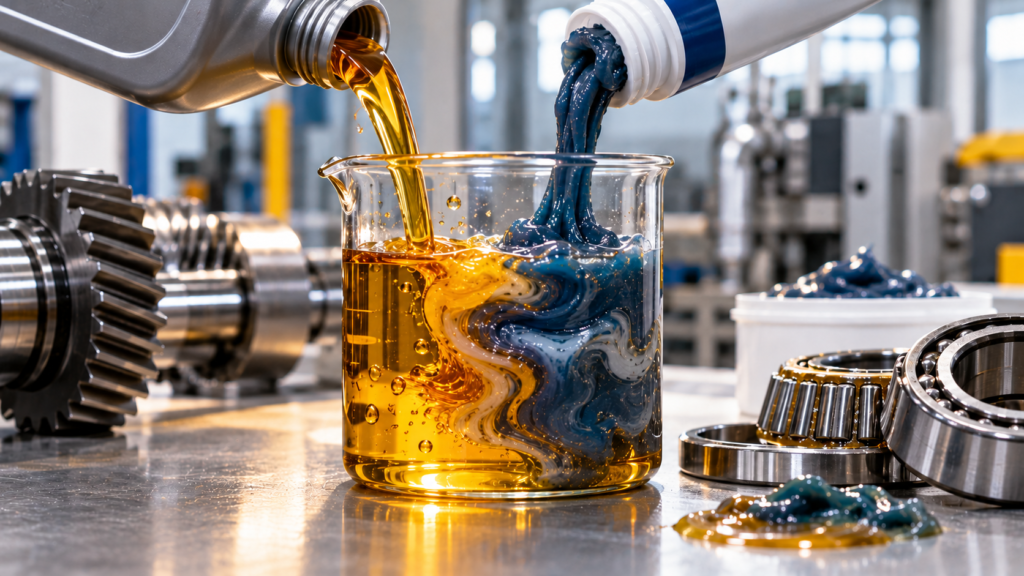

Industrial lubricants are formulated to meet specific equipment requirements, including viscosity, load-carrying capacity, temperature resistance and material compatibility. When different oils or greases mix unintentionally, the resulting lubricant may no longer deliver the performance expected from either product.
This issue, known as industrial lubricant cross-contamination, can affect machinery ranging from electric motors and bearings to hydraulic systems, compressors and industrial gearboxes. Even when both lubricants are individually suitable for their intended applications, their combination may alter important performance characteristics.
For industrial maintenance teams, preventing cross-contamination is an essential part of equipment reliability. Correct storage, clean transfer equipment, controlled lubricant changes and appropriate maintenance procedures help protect machinery from avoidable lubrication problems.
What Is Industrial Lubricant Cross-Contamination?
Industrial lubricant cross-contamination occurs when an unwanted substance or incompatible lubricant enters an oil or grease system. This can happen when two different lubricants are mixed, when the wrong product is added during maintenance, or when external contaminants enter through storage, handling or operating equipment.
Cross-contamination can involve:
- Mixing different industrial gear oils or hydraulic oils
- Combining greases with incompatible thickener systems
- Introducing mineral oil into a system designed for a particular synthetic lubricant
- Contaminating fresh oil with water, dirt or metal particles
- Using transfer containers, pumps or dispensing lines that retain another lubricant
- Mixing new lubricant with degraded or unidentified oil already present in the equipment
Not every mixture causes immediate damage. Some lubricants are compatible under specific conditions, while others may interact adversely. The risk depends on the products’ formulations, concentrations, operating temperatures and equipment requirements.
The important point is that lubricant compatibility should be verified rather than assumed simply because two products have similar colours, viscosities or applications.
Common Causes of Lubricant Cross-Contamination
Understanding how contamination occurs helps maintenance teams identify weaknesses in their lubrication practices.
1. Mixing Different Lubricant Grades
Lubricants designed for different operating conditions may have different viscosity grades and additive systems. Mixing them can change the viscosity and alter the performance expected from the original formulation.
For example, combining hydraulic oils of different viscosity grades may affect the fluid’s suitability for the system’s operating temperature and pressure. Similarly, mixing industrial gear oils without checking compatibility may affect the lubricant’s intended performance.
Even products from the same manufacturer should not automatically be assumed to be interchangeable. The specific product grades and technical requirements must be checked.
2. Mixing Mineral and Synthetic Oils
Mineral and synthetic base oils are not automatically incompatible. Some formulations can be mixed, while others may have limitations arising from their base oils, additives, seals or intended applications.
Problems can arise when the resulting blend no longer meets the equipment manufacturer’s requirements or the performance specifications of the original lubricant.
This is particularly important when changing to specialised synthetic lubricants. Maintenance teams should follow the lubricant supplier’s changeover instructions, including any required draining, cleaning or flushing procedures.
3. Mixing Incompatible Greases
Grease compatibility requires particular attention because greases contain a thickener in addition to base oil and additives. Common thickener types include lithium, lithium complex, calcium sulfonate complex, polyurea and aluminium complex.
When incompatible greases mix, their consistency and mechanical stability may change. The mixture may soften, harden, separate oil or lose its ability to remain in the intended lubrication area.
However, thickener type alone does not provide a complete compatibility assessment. Formulation, base oil, additives and operating conditions also matter. Before changing grease products, check the manufacturers’ compatibility guidance and the equipment requirements.
4. Contamination During Storage and Transfer
Lubricant contamination often occurs before the product reaches the machine.
Unlabelled containers, shared dispensing equipment, open drums and poorly maintained transfer lines can introduce remnants of another lubricant, moisture or airborne particles into fresh oil or grease.
Using dedicated, clearly labelled storage and dispensing equipment helps reduce this risk. Containers should be kept closed when not in use, and lubricant transfer practices should protect the product from contamination.
How Cross-Contamination Affects Equipment Performance
The consequences of mixing lubricants depend on the equipment and the nature of the contamination. In some cases, performance changes may be gradual; in others, the lubricant may become unsuitable for continued operation.
1. Changes in Viscosity and Lubricating Film
Viscosity influences the lubricant film that separates moving surfaces. If incompatible or significantly different viscosity grades are mixed, the resulting viscosity may fall outside the equipment’s required operating range.
A lubricant that is too thin may not maintain sufficient film thickness under the operating load. Excessively high viscosity can increase frictional losses, restrict flow in some systems and make cold starts more difficult.
These effects can contribute to increased wear, operating temperature and reduced equipment efficiency.
2. Reduced Additive Performance
Industrial lubricants contain carefully balanced additive packages to support properties such as oxidation resistance, antiwear protection, corrosion control and foam management.
Mixing different formulations may change the concentration or interaction of these additives. In some cases, the resulting blend may not provide the same level of performance as either original product.
This does not mean that every mixture will cause additive failure. The actual outcome depends on the formulations involved and should be established through manufacturer guidance or appropriate testing.
3. Grease Softening, Hardening or Separation
When incompatible greases are combined, their thickener systems may interact and change the grease’s consistency or stability.
A grease that becomes too soft may leak or fail to remain in the lubrication zone. A grease that hardens may not flow adequately to the contact surfaces. Oil separation can also affect the grease’s ability to provide consistent lubrication.
These changes can be particularly problematic in electric motor bearings, conveyor bearings and other components where grease retention and replenishment are important.
4. Increased Wear and Operating Temperature
If cross-contamination compromises the lubricant film or protective additives, friction and wear may increase. The resulting heat can further accelerate lubricant degradation, creating a cycle of worsening lubrication conditions.
In gearboxes and heavily loaded bearings, this may contribute to surface damage and reduced component life. In hydraulic systems, unsuitable fluid properties or contamination can affect component protection and system operation.
5. Seal, Filter and System Compatibility Issues
A lubricant change can also affect seals, filtration and fluid-system behaviour. Certain formulations may not be suitable for particular seal materials, while contamination or degradation products can contribute to deposits or filter blockage.
This is why compatibility should be assessed for the complete application rather than based solely on whether the two oils appear to mix evenly.
How to Prevent Industrial Lubricant Cross-Contamination
A structured lubrication management programme helps prevent contamination during storage, maintenance and equipment operation.
1. Establish a Clear Lubricant Identification System
Label each lubricant by product name, grade, application and any relevant handling requirements. Colour coding may provide an additional visual aid, but it should never replace clear labelling.
Maintain an updated lubricant register so maintenance teams can identify the correct product for each machine.
2. Use Dedicated Transfer and Dispensing Equipment
Where practical, assign separate pumps, containers, hoses and dispensing tools to different lubricant types. If shared equipment is unavoidable, establish an appropriate cleaning procedure before changing products.
Keep containers closed and store them in a clean, dry area to minimise exposure to dust and moisture.
3. Follow a Controlled Lubricant Changeover Procedure
Before changing an industrial lubricant, verify whether the existing and replacement products are compatible.
Depending on the application, the changeover may require draining the old lubricant, cleaning the reservoir, replacing filters or flushing the system. Follow the lubricant manufacturer’s and equipment manufacturer’s instructions rather than applying the same procedure to every machine.
4. Verify Grease Compatibility Before Replenishment
Before adding a different grease to a bearing or lubrication point, confirm compatibility with the grease already present.
If compatibility is uncertain, obtain guidance from the lubricant manufacturer or equipment supplier. A controlled changeover may be necessary to avoid leaving an unsuitable mixture inside the component.
5. Monitor Lubricant Condition
Regular oil analysis can help identify changes in viscosity, water content, oxidation and contamination. Depending on the application, analysis may also include particle counts, elemental analysis or other tests.
Grease condition can be assessed through appropriate inspection and testing methods where justified by the equipment’s criticality.
Monitoring results should be interpreted against baseline data, lubricant specifications and operating history. Testing is most useful when it supports a defined maintenance decision rather than simply generating measurements.
6. Train Maintenance and Procurement Teams
Cross-contamination can result from simple operational errors, including selecting the wrong container or topping up equipment with an unidentified lubricant.
Training should cover lubricant identification, storage, transfer, changeover procedures and escalation when product compatibility is uncertain. Procurement teams should also ensure that replacement products meet the required specifications rather than relying on approximate product descriptions.
What to Do If Lubricant Cross-Contamination Is Suspected
If a lubricant has been mixed with an unknown or potentially incompatible product, avoid assuming that the equipment can continue operating safely.
A practical response should include the following steps:
- Identify the products involved: Record the original lubricant, the added product and the approximate quantity introduced.
- Assess the equipment risk: Consider the machine’s criticality, operating conditions and the possible consequences of continued operation.
- Consult the relevant technical guidance: Contact the lubricant supplier or equipment manufacturer to determine whether the mixture is acceptable.
- Arrange testing where appropriate: Oil analysis or compatibility testing may help establish whether the lubricant remains suitable for service.
- Follow the recommended corrective procedure: Depending on the findings, this may involve continued monitoring, draining, flushing, filter replacement or relubrication.
- Document the incident: Record the cause and corrective action to help prevent recurrence.
For critical machinery, follow the site’s safety and shutdown procedures when contamination could threaten equipment integrity or safe operation. Do not rely on appearance alone to determine whether a lubricant mixture is acceptable.
How Mobil Industrial Lubricants Fit into a Contamination-Control Strategy
Mobil offers industrial lubricants for applications including hydraulic systems, gearboxes, compressors, bearings and circulating-oil systems. Selecting the correct Mobil lubricant requires matching the product to the equipment specification and operating conditions.
When evaluating a Mobil lubricant change, maintenance teams should verify:
- The required viscosity grade and performance specification
- Compatibility with the existing lubricant
- Seal and material compatibility
- Any product-specific flushing or changeover requirements
- The manufacturer’s recommended oil analysis and maintenance practices
Switching to a different Mobil product does not automatically require flushing in every application, nor does using products from the same brand guarantee compatibility. The decision should be based on the specific formulations and the equipment manufacturer’s requirements.
For businesses using Mobil industrial lubricants, a documented lubricant register and controlled changeover process can reduce the risk of accidental mixing and help maintain consistent equipment performance.
How Godavaritech Supports Mobil Lubricant Sourcing
Godavaritech supplies industrial products, including Mobil lubricants, for businesses seeking solutions suited to their machinery and operating requirements.
When sourcing a replacement lubricant, maintenance and procurement teams should provide the equipment make and model, existing lubricant name, viscosity grade, operating conditions and any relevant compatibility concerns. This information helps narrow down suitable product options and reduces the risk of selecting an inappropriate replacement.
Where cross-contamination is suspected, product selection should be supported by the relevant technical documentation and, where necessary, advice from the lubricant manufacturer or equipment OEM.
Conclusion
Industrial lubricant cross-contamination can affect viscosity, additive performance, grease consistency, wear protection and overall equipment reliability. The severity depends on the products involved, the quantity mixed and the conditions under which the machinery operates.
Preventing these problems requires clear lubricant identification, dedicated dispensing equipment, controlled product changes, compatibility checks and appropriate condition monitoring. When contamination is suspected, the correct response is to identify the products involved and follow a technically supported corrective procedure.
For businesses using Mobil industrial lubricants, effective lubricant management helps reduce avoidable maintenance risks and supports more reliable industrial operations. Godavaritech can assist with Mobil lubricant sourcing based on the equipment’s technical requirements.
Frequently Asked Questions
1. What is industrial lubricant cross-contamination?
Industrial lubricant cross-contamination occurs when an unwanted lubricant or substance enters an oil or grease system. It can alter lubricant properties and affect equipment performance.
2. Can different industrial oils be mixed?
Some industrial oils are compatible, while others may not be. Compatibility should be verified using the product specifications and lubricant manufacturer’s guidance before mixing or changing products.
3. What happens when incompatible greases are mixed?
Incompatible greases may soften, harden or separate oil, potentially reducing their ability to lubricate and remain in place. Compatibility depends on the complete formulations, not only the thickener type.
4. How can lubricant cross-contamination be prevented?
Use clearly labelled containers, dedicated dispensing equipment, controlled changeover procedures and verified lubricant specifications. Regular condition monitoring can help identify contamination during service.
5. Can Mobil industrial lubricants be mixed with other lubricants?
Compatibility depends on the specific Mobil product and the other lubricant involved. Check the relevant technical documentation and obtain manufacturer guidance before mixing products or changing lubricants.
6. Where can businesses source Mobil industrial lubricants in India?
Businesses can approach Godavaritech for Mobil lubricant sourcing and discuss their equipment requirements. The selected product should meet the machine manufacturer’s specifications and any applicable compatibility requirements.