
Selecting the correct bearing is not only about choosing the right bearing type or size. Industrial bearings often carry a combination of numbers, letters, prefixes and suffixes that communicate important information about their construction, dimensions, internal clearance, sealing, cage design and other features.
For maintenance engineers, procurement teams and machine designers, understanding these designations can make bearing identification and replacement significantly easier.
With Schaeffler Bearings, the designation system provides a structured way to identify important characteristics of a bearing. Schaeffler’s technical documentation explains that a bearing designation can indicate its type, dimensions, tolerances, internal clearance and other important features. The basic designation, prefixes and suffixes each serve different purposes.
For businesses sourcing Premium Industrial Bearings, understanding these codes can also help prevent incorrect replacements and unnecessary equipment downtime.
What Is a Bearing Designation?
A bearing designation is essentially a coded identification system made up of numbers and letters.
A typical designation can communicate information such as:
- Bearing type
- Bearing series
- Bore diameter
- Width or diameter series
- Internal clearance
- Cage construction
- Sealing or shielding
- Tapered bore
- Special design features
- Other application-specific modifications
Schaeffler notes that the basic designation generally identifies the bearing series and bore, while prefixes and suffixes can provide additional information about bearing components and special designs.
For example, a designation such as:
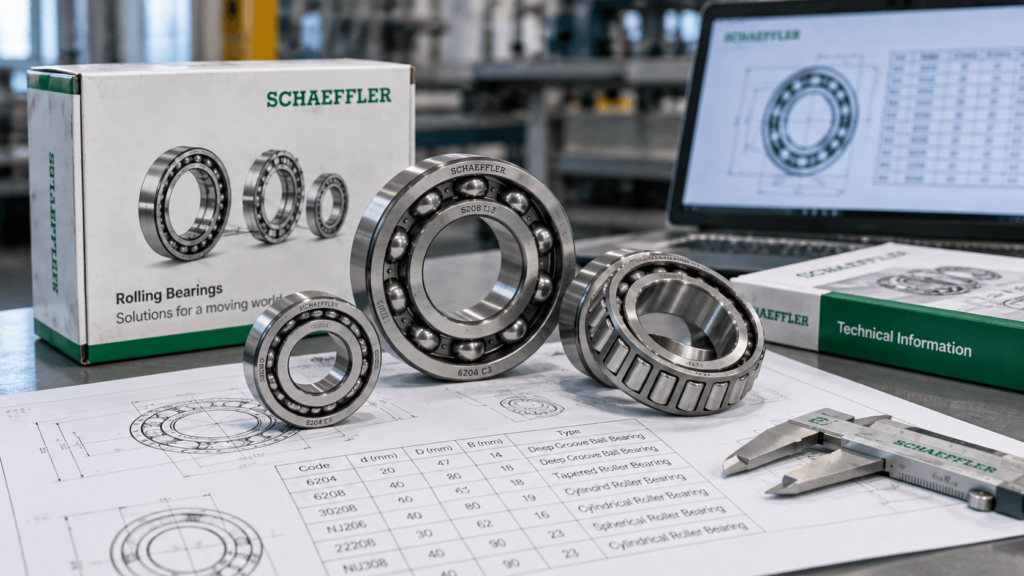
6208
contains information that helps identify the bearing’s series and bore size.
Additional designations can then modify the standard bearing configuration.
Breaking Down the Main Parts of a Schaeffler Bearing Code
Although bearing designation systems can vary according to bearing type, most designations can be understood by looking at three main elements:
Basic designation + Prefix + Suffix
Each has a different function.
1. Basic Designation
The basic designation normally provides the fundamental identification of the bearing.
It can indicate:
- Bearing series
- Bearing type
- Dimension series
- Bore designation
For many commonly used metric rolling bearings, the final two digits of the basic designation can provide the bore code.
For example, in commonly used bearing designations:
- 00 = 10 mm bore
- 01 = 12 mm bore
- 02 = 15 mm bore
- 03 = 17 mm bore
From 04 onwards, the bore code is generally multiplied by five to obtain the nominal bore diameter in millimetres.
Therefore:
- 04 = 20 mm
- 05 = 25 mm
- 06 = 30 mm
- 08 = 40 mm
- 10 = 50 mm
However, this should not be treated as a universal decoding rule for every Schaeffler bearing. Different bearing families and special designs can use different designation structures.
The specific product catalogue should therefore be checked before ordering.
2. Understanding Bearing Series Numbers
The first part of a bearing designation can provide information about its bearing family or series.
For example, common deep groove ball bearing series include:
- 60 series
- 62 series
- 63 series
- 64 series
These series represent different dimensional arrangements and load-carrying characteristics.
A 6205, for example, belongs to the 62 series and has a 25 mm bore.
Schaeffler’s FAG product information shows how bearing series and bore reference numbers work together to identify different deep groove ball bearings.
The series should not be interpreted simply as a ranking from “small” to “large”. Bearing selection also depends on load, speed, available installation space, operating conditions and other design requirements.
3. What Do Bearing Suffixes Mean?
Suffixes are particularly important because they can indicate modifications to the standard bearing configuration.
Depending on the bearing family, suffixes may describe:
- Internal clearance
- Cage material
- Sealing
- Shielding
- Bearing design
- Tapered bore
- Special internal geometry
- Material or performance characteristics
For example, Schaeffler/FAG documentation identifies designations such as C3, M, 2RSR and 2ZR for particular bearing families.
C3 – Increased Radial Internal Clearance
C3 indicates radial internal clearance greater than normal.
This can be important in applications where operating temperatures, fits or operating conditions require additional internal clearance.
It should not automatically be interpreted as “better” than normal clearance.
The correct clearance depends on the application.
M – Machined Brass Cage
In relevant FAG bearing designations, M identifies a machined brass cage.
Cage material can influence the bearing’s suitability for particular loads, speeds and operating environments.
2RSR – Sealing on Both Sides
For applicable FAG deep groove ball bearings, 2RSR indicates seals on both sides.
Seals can help retain lubricant and protect the rolling elements from contamination.
2ZR – Shields on Both Sides
2ZR identifies a bearing with shields on both sides in the applicable FAG designation system.
The distinction between seals and shields matters because their friction, protection characteristics and speed suitability can differ.
Schaeffler’s technical information also explains that sealing arrangements influence contamination protection, lubricant retention, friction and bearing temperature.
4. Prefixes: What Do They Tell You?
Prefixes generally appear before the basic designation.
Schaeffler explains that prefixes normally identify individual bearing parts of complete bearings, although in some cases they can form part of the basic designation.
This becomes particularly relevant with specialised bearing configurations where individual components or assemblies require additional identification.
Therefore, a bearing code should be read as a complete designation rather than by focusing only on the final numbers.
5. Tapered Bore Designations
Some industrial bearings have a tapered bore rather than a cylindrical bore.
A commonly encountered designation is:
K
For applicable Schaeffler bearing families, K indicates a tapered bore with a standard taper of 1:12.
Certain heavy-series bearings can use:
K30
which indicates a 1:30 taper.
Schaeffler’s fluid-pump bearing documentation provides an example designation containing K and K30 and explains their relationship to tapered bore configurations.
This distinction is important during installation because tapered-bore bearings are typically mounted differently from bearings with cylindrical bores.
6. Radial Internal Clearance Codes
Internal clearance is another important part of bearing identification.
Common designations include:
- CN – normal radial internal clearance
- C3 – greater than normal clearance
- C4 – greater than C3
Schaeffler documentation specifically identifies CN, C3 and C4 in applicable bearing designation systems.
The correct clearance should be determined according to the operating conditions rather than selected simply because a larger clearance appears more robust.
Factors such as:
- Shaft and housing fits
- Operating temperature
- Speed
- Load
- Thermal expansion
can influence the required internal clearance.
7. Cage Designations Matter Too
The cage keeps the rolling elements appropriately spaced and guides their movement.
Different cage materials and constructions can therefore influence bearing performance.
Depending on the bearing type, Schaeffler designations can identify cages made from:
- Sheet steel
- Glass-fibre-reinforced polyamide
- Brass
For example, Schaeffler’s bearing designation information includes JPA, TVB, M, MA, MB and other cage-related designations for particular spherical roller bearing configurations.
This demonstrates why simply identifying the bearing’s basic number may not be enough when replacing an industrial bearing.
A Practical Example: Reading a Bearing Designation
Consider a designation such as:
6208-2RSR-C3
The designation can be interpreted broadly as:
6208 → basic bearing designation
2RSR → sealing configuration for the applicable FAG bearing family
C3 → increased radial internal clearance
The important point is that the suffixes are not decorative additions. They identify changes to the standard configuration.
Replacing this bearing with a standard 6208 without checking the application’s requirements could therefore result in a different configuration.
The same principle applies to more complex industrial bearings.
For example, Schaeffler documentation provides the designation:
23122-E1A-XL-K-M-C3 + H3122
Here, different sections identify the bearing series, design modification, X-life version, tapered bore, cage, internal clearance and associated adapter sleeve.
This illustrates how a single industrial bearing designation can encode a considerable amount of technical information.
Why Bearing Codes Matter in Industrial Maintenance
Incorrect bearing identification can lead to much more than a procurement inconvenience.
Installing an incorrect bearing configuration can affect:
Equipment performance
The wrong internal clearance, cage or sealing arrangement may not match the machine’s operating conditions.
Bearing life
A bearing that is dimensionally similar but technically different may have different operating characteristics.
Maintenance intervals
Sealing, lubrication and internal clearance can influence maintenance requirements.
Installation
A cylindrical-bore bearing and tapered-bore bearing may require completely different mounting arrangements.
Equipment reliability
A bearing is part of a larger machine system. The correct bearing configuration must work with the shaft, housing, lubrication system, load and operating environment.
This is why working with a knowledgeable Schaeffler Bearing Supplier can be valuable when the designation is complex or the original bearing is unavailable.
Bearing Number vs Bearing Specification: They Are Not the Same
A common mistake is to assume that matching the main bearing number is sufficient.
For example, two bearings may share the same basic designation while having different:
- Seals
- Shields
- Internal clearances
- Cage materials
- Bore configurations
- Special modifications
Schaeffler states that the designation can identify dimensions, tolerances, internal clearance and other important characteristics.
Therefore, procurement teams should record the complete designation, not just the basic number.
How to Verify a Schaeffler Bearing Before Ordering
Before purchasing a replacement, it is useful to follow a structured verification process.
Step 1: Record the complete bearing designation
Capture every number, letter, prefix and suffix visible on the bearing.
Step 2: Check the bearing family
Identify whether it is a deep groove ball bearing, cylindrical roller bearing, spherical roller bearing, tapered roller bearing or another configuration.
Step 3: Verify dimensions
Check:
- Bore diameter
- Outside diameter
- Width
For instance, the FAG 6205 product listing specifies a 25 mm inner diameter, 52 mm outer diameter and 15 mm width.
Step 4: Check suffixes
Do not ignore codes such as C3, sealing designations or cage identifiers.
Step 5: Check the application
Consider:
- Speed
- Load
- Temperature
- Lubrication
- Contamination
- Alignment
- Installation method
Step 6: Verify the manufacturer’s catalogue
Where the designation is unusual or incomplete, use the relevant Schaeffler technical documentation or product catalogue rather than relying solely on an online bearing-number lookup.
Step 7: Source through a reliable supplier
A technically correct bearing designation is only useful if the supplied product is genuine and correctly matched to the requirement.
For industries sourcing Schaeffler Bearings Supplier India solutions, a knowledgeable distributor can help verify the complete product specification before procurement.
Why Genuine Schaeffler Bearings Matter
Bearing designation knowledge is also useful for avoiding incorrect or counterfeit products.
A product that appears to have the correct basic number may still differ in construction, materials, clearance, sealing or other characteristics.
Schaeffler’s own training programme includes bearing designation fundamentals alongside brand-protection and counterfeit-awareness training, highlighting the importance of both correct identification and authentic products.
For critical machinery, purchasing through an Authorized Distributor for Schaeffler can provide an additional layer of confidence around product identification and sourcing.
Godavaritech supports industrial customers looking for Schaeffler products supplier India solutions, helping businesses identify and source appropriate Schaeffler products according to their application requirements.
Common Mistakes When Reading Bearing Codes
Reading only the first few numbers
The basic designation may not tell the complete story.
Assuming every suffix has the same meaning
Designation conventions can vary between bearing families. Always refer to the relevant Schaeffler documentation.
Choosing C3 automatically
Higher clearance is not universally better. It needs to match the application.
Ignoring seals and shields
The sealing configuration can influence contamination protection, lubrication retention, friction and operating temperature.
Replacing a tapered-bore bearing with a cylindrical-bore bearing
The installation arrangement can be fundamentally different.
Matching dimensions but ignoring operating conditions
Two dimensionally compatible bearings may not be equivalent for a particular machine.
Final Takeaway
A Schaeffler bearing designation is much more than a product number. It is a compact technical language that can communicate the bearing’s series, dimensions, clearance, sealing, cage, bore configuration and other design characteristics.
Understanding these codes helps maintenance and procurement teams reduce identification errors, select the correct replacement and communicate more effectively with suppliers.
For complex applications, however, bearing identification should not rely on the designation alone. Load, speed, temperature, lubrication, mounting conditions and the overall bearing arrangement must also be considered.
For industries sourcing Premium Industrial Bearings, partnering with a reliable Schaeffler Bearing Supplier can make the process of identifying and procuring the correct bearing more dependable.
Frequently Asked Questions
1. What does a Schaeffler bearing number indicate?
A Schaeffler bearing designation can identify the bearing type, dimensions and other characteristics such as internal clearance or special design features. Schaeffler Bearings Supplier India teams can help verify the complete designation when required.
2. What does C3 mean on a Schaeffler bearing?
C3 generally indicates radial internal clearance greater than normal for the applicable bearing family. The correct clearance should be selected according to the application’s operating conditions.
3. What does 2RSR mean on an FAG bearing?
For applicable FAG deep groove ball bearings, 2RSR identifies sealing on both sides. The sealing arrangement helps protect the bearing from contamination and retain lubricant.
4. What does K mean in a Schaeffler bearing designation?
For applicable bearing families, K indicates a tapered bore with a 1:12 taper. The exact designation should always be verified against the relevant Schaeffler Group Products documentation.
5. Can two bearings with the same basic number be different?
Yes. Additional suffixes can indicate differences in sealing, clearance, cage construction or other features. A Schaeffler Bearing Supplier should therefore verify the complete designation before replacement.
6. Where can industries source genuine Schaeffler Bearings?
Industries should source Schaeffler Bearings through an authorised and reliable distribution channel and verify the complete product designation before purchase.