
Industrial equipment rarely fails without warning. In many cases, changes in lubricant condition, contamination levels, or wear particles appear before a major component failure occurs. The challenge is identifying these early indicators and turning them into actionable maintenance decisions.
This is where Mobil Lubricant Analysis and oil condition monitoring can play an important role.
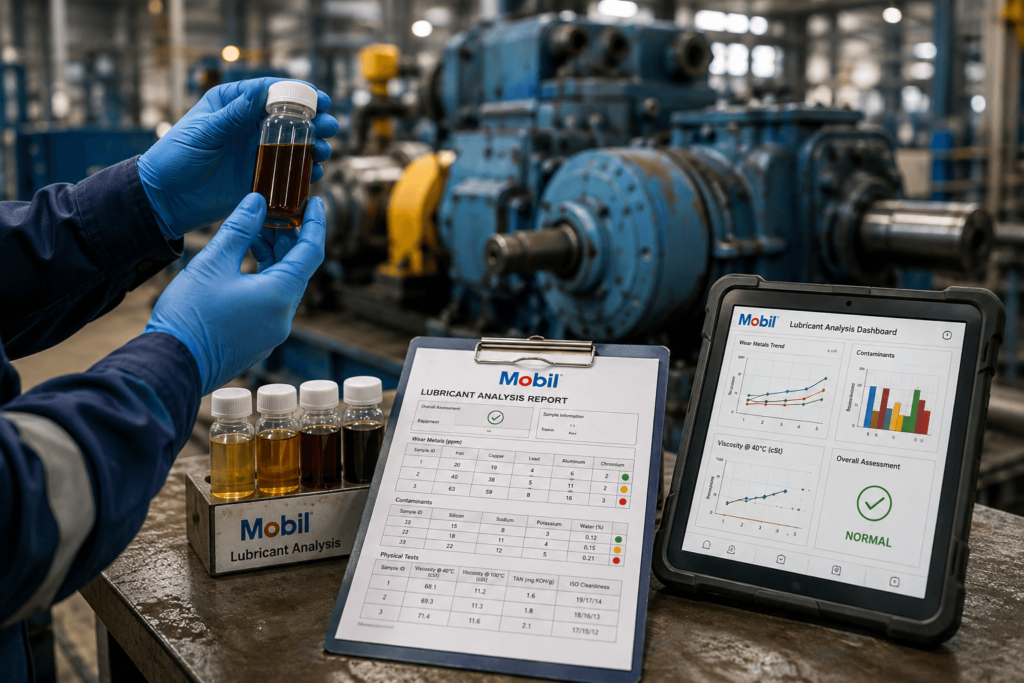
Used oil analysis allows maintenance teams to examine changes in lubricant properties, contaminants, and equipment wear debris. Mobil explains that its lubricant analysis programme is designed to help identify equipment problems, improve equipment durability, reduce unscheduled downtime, and support better maintenance decisions.
For industries relying on Mobil Industrial Lubricants, oil analysis can therefore become an important part of a broader reliability programme.
Whether the equipment involves hydraulic systems, gearboxes, compressors, turbines, bearings, paper machines, or other critical assets, monitoring the condition of the lubricant can provide valuable information about what is happening inside the machine.
What Is Mobil Lubricant Analysis?
Mobil Lubricant Analysis is a used-oil analysis programme designed to evaluate both lubricant and equipment condition.
A lubricant sample can provide information about three important areas:
- Equipment condition
- Lubricant condition
- Contamination
Mobil’s analysis methodology uses these areas to help identify abnormal conditions and determine whether corrective action or continued monitoring is appropriate.
Instead of waiting for a machine to develop obvious symptoms such as excessive vibration, overheating, unusual noise, or complete failure, oil analysis can provide an additional source of information for maintenance teams.
This makes lubricant analysis particularly useful for equipment where unexpected downtime can have a significant impact on production.
Why Oil Condition Monitoring Matters for Industrial Equipment
Traditional maintenance strategies often rely on fixed inspection or replacement schedules. While preventive maintenance can reduce some risks, it does not always account for the actual condition of an individual machine.
Oil condition monitoring provides a more condition-based approach.
By tracking changes over time, maintenance teams can identify trends that may indicate:
- Increasing component wear
- Lubricant degradation
- Water contamination
- Dirt or particle contamination
- Abnormal operating conditions
- Cooling-system problems
- Lubrication issues
Mobil’s technical guidance describes oil analysis as a condition-monitoring tool that can help improve equipment reliability, reduce maintenance costs, and enhance equipment life.
The objective is not simply to test oil. It is to use the information from the analysis to make better maintenance decisions.
How Does Oil Analysis Detect Equipment Problems?
A lubricant continuously circulates through many critical machine components. During operation, it can collect information in the form of wear particles, contaminants, and changes in its physical or chemical properties.
Laboratory analysis can identify these changes.
For example, an increase in particular wear metals may indicate component wear, while changes in viscosity or contamination levels can indicate lubricant or equipment-related problems.
Mobil’s powertrain analysis, for example, monitors transmission, differential, and final-drive oils for premature wear, contamination, and oil condition. Metal analysis can help identify component wear or harmful contamination entering the oil.
The key advantage is that maintenance teams can potentially identify developing problems before they become expensive failures.
What Does Mobil Lubricant Analysis Test?
The exact tests depend on the equipment and lubricant being analysed.
Common analysis parameters can include:
- Viscosity
- Wear metals
- Contaminant metals
- Water
- Oxidation
- Total Acid Number
- Particle count
- Fuel dilution
- Coolant indicators
- Other application-specific parameters
Mobil’s system-analysis service, for example, evaluates hydraulic, circulating, gear, and compressor oils using tests such as viscosity, water, oxidation, TAN, particle count, PQ index, and metals, with additional tests depending on the application.
The purpose is not to perform every possible test on every sample. Testing should be relevant to the equipment, lubricant, and operating conditions.
Understanding the Three Key Areas of Oil Analysis
1. Equipment Condition
Oil analysis can help identify evidence of component wear.
Wear particles generated inside equipment can enter the lubricant and subsequently be detected during laboratory analysis.
For example, increasing levels of specific metals may indicate wear occurring within machine components.
This information can help maintenance teams investigate an asset before the problem becomes severe.
2. Lubricant Condition
Lubricants change during operation.
High temperatures, oxidation, contamination, mechanical stress, and extended operating periods can affect lubricant performance.
Monitoring lubricant condition helps determine whether the oil is still suitable for continued operation or whether corrective action may be required.
3. Contamination
Contamination can significantly affect lubricant and equipment performance.
Potential contaminants include:
- Water
- Dirt
- Dust
- Process chemicals
- Coolant
- Wear debris
Mobil’s contamination-control programme uses equipment inspections and oil sampling to identify abnormal conditions and provide recommendations relating to filtration, reclamation, oil changes, and other corrective actions.
Why Trending Is More Important Than a Single Oil Test
One of the most important principles of oil condition monitoring is that a single result does not always provide the complete picture.
A result may fall outside a normal range without necessarily indicating immediate equipment failure.
Mobil’s experience with used-oil analysis highlights the importance of reviewing the complete set of test results and monitoring trends over time rather than relying on one isolated parameter.
For example, maintenance teams can compare:
Previous result → Current result → Trend → Recommended action
A gradual increase in wear metals, contamination, or lubricant degradation may be more significant than one isolated abnormal reading.
This makes consistent sampling particularly important.
How to Build an Effective Oil Condition Monitoring Programme
A successful programme requires more than periodically sending oil samples to a laboratory.
Step 1: Identify Critical Equipment
Start by identifying equipment where failure would have a significant impact on:
- Production
- Safety
- Maintenance costs
- Equipment availability
- Product quality
Critical assets should receive greater monitoring priority.
Step 2: Establish Sampling Frequencies
Sampling frequency should reflect equipment criticality, operating conditions, lubricant type, and historical performance.
Equipment operating continuously under severe conditions may require more frequent monitoring than less-critical machinery.
Step 3: Take Representative Samples
Sample quality matters.
A contaminated or poorly collected sample can produce misleading results.
Sampling procedures should be consistent so that results from different periods can be compared effectively.
Step 4: Establish Baselines
A baseline helps maintenance teams understand what normal operating conditions look like for a particular machine.
Future samples can then be compared with historical results.
Step 5: Trend the Results
Monitoring trends helps identify gradual changes that may otherwise go unnoticed.
Step 6: Take Corrective Action
Analysis becomes valuable when the results lead to appropriate action.
Depending on the findings, corrective action may involve:
- Inspection
- Filtration
- Lubricant replacement
- Contamination control
- Component inspection
- Lubrication adjustment
- Planned maintenance
Mobil’s analysis programme provides recommendations and comments when improvements are required, rather than simply presenting laboratory data.
Mobil Lubricant Analysis for Hydraulic Systems
Hydraulic equipment depends heavily on lubricant cleanliness and condition.
Contaminated or degraded hydraulic oil can affect valves, pumps, actuators, and other components.
Oil analysis can monitor parameters such as:
- Viscosity
- Water
- Oxidation
- Particle count
- Metals
- Acid number
Mobil’s system analysis specifically includes hydraulic oil analysis and provides additional testing options for hydraulic applications.
For industries using Mobil Hydraulic Oil, regular condition monitoring can therefore support a more proactive hydraulic maintenance strategy.
Mobil Lubricant Analysis for Gearboxes
Gearboxes operate under significant mechanical loads and can experience gear and bearing wear.
Oil analysis can help maintenance teams monitor:
- Wear metals
- Contamination
- Lubricant condition
- Changes in viscosity
Mobil’s powertrain analysis is designed to monitor oils for premature wear, contamination, and oil condition, helping identify potential gear or transmission problems before they lead to costly downtime.
For industrial gearboxes, combining appropriate Mobil Industrial Lubricants with regular oil condition monitoring can support longer equipment life and more informed maintenance planning.
Mobil Lubricant Analysis for Compressors
Compressors can operate continuously and are often critical to production processes.
Oil analysis can help monitor lubricant condition and identify signs of wear or contamination.
Mobil’s lubricant analysis programme includes compressor analysis as one of its application-specific testing options.
This can be particularly valuable where compressor failure could interrupt production or increase maintenance costs.
Mobil Lubricant Analysis for Paper Machines
Paper manufacturing equipment requires continuous operation and dependable lubrication.
Mobil provides paper-machine oil analysis designed to monitor circulation oils for premature wear, contamination, and lubricant condition. The service can be applied to dryer bearing lubrication systems, press lubrication systems, and controlled-crown roll systems.
This demonstrates how oil analysis can be tailored to specific equipment rather than relying on a one-size-fits-all testing programme.
From Oil Analysis to Real-Time Oil Condition Monitoring
Traditional lubricant analysis relies on collecting samples and sending them for testing. While this remains valuable, connected technologies are creating opportunities for more frequent monitoring.
Mobil Serv Real Time is designed as an oil condition monitoring solution using Industrial Internet of Things technology.
Mobil states that the system can build data trends, provide alerts when common causes of damage are detected, help optimise oil drain intervals, and support a shift from preventive to predictive maintenance.
This approach can be especially useful for critical assets where waiting for periodic laboratory sampling may not provide sufficient monitoring frequency.
Oil Analysis vs Real-Time Condition Monitoring
Both approaches can contribute to equipment reliability, but they serve different purposes.
| Oil Analysis | Real-Time Monitoring |
| Periodic oil sampling | Continuous or frequent monitoring |
| Laboratory-based testing | Sensor and data-based monitoring |
| Detailed lubricant analysis | Rapid trend and condition information |
| Wear and contamination analysis | Immediate alerts for selected conditions |
| Useful for scheduled condition checks | Useful for critical assets requiring frequent monitoring |
The two approaches can also complement each other.
A plant may use real-time monitoring for immediate condition changes while using laboratory oil analysis for deeper periodic lubricant and wear assessment.
How Mobil Industrial Lubricants Fit Into a Reliability Strategy
Lubricant selection and condition monitoring should not be treated as separate activities.
The right lubricant can help protect equipment under its intended operating conditions, while analysis helps determine how that lubricant and the equipment are performing in service.
Mobil’s industrial lubricant portfolio includes mineral and synthetic oils, greases, hydraulic oils, compressor oils, gear oils, and other products designed for different industrial applications.
Mobil’s application portfolio includes:
- Bearings
- Gears
- Hydraulic systems
- Air compressors
- Turbines
- Wind turbines
- Paper machines
- Heat-transfer systems
- Metalworking equipment
This makes condition monitoring particularly relevant for industries using different Mobil lubricants across multiple types of equipment.
How Oil Condition Monitoring Can Reduce Unplanned Downtime
Unexpected equipment failure can lead to:
- Production interruptions
- Emergency maintenance
- Replacement-part costs
- Labour costs
- Lost production
- Secondary equipment damage
Oil condition monitoring can help shift maintenance decisions from reactive to condition-based.
If an oil sample indicates increasing wear or contamination, maintenance teams may have an opportunity to investigate the equipment during a planned maintenance window.
Mobil describes its lubricant analysis programme as a way to help reduce unscheduled downtime, improve equipment durability, and increase productivity.
The exact financial benefit will depend on the equipment, operating conditions, maintenance programme, and actions taken in response to analysis results.
Choosing the Right Mobil Lubricant Distributor in India
Implementing an effective lubrication and condition-monitoring programme often requires more than purchasing lubricant.
Industries may also need support with:
- Lubricant selection
- Application recommendations
- Oil sampling
- Analysis interpretation
- Equipment troubleshooting
- Lubrication programme development
Mobil’s industrial services information states that field-based lubrication engineers can provide guidance on lubrication practices, lubricant selection, equipment troubleshooting, and related services through distributors.
For businesses searching for a Mobil lubricants distributor in India, Mobil distributor in India, or Mobil India distributor, technical support should therefore be considered alongside product availability.
Mobil India’s official distributor information states that its authorised distributors are required to meet requirements relating to product quality and handling, training, qualification, and brand representation.
Why Genuine Mobil Industrial Lubricants Matter
Oil analysis can provide useful information only when the lubricant itself is correctly selected and managed.
Using the wrong lubricant can affect:
- Viscosity
- Additive performance
- Operating temperature
- Component protection
- Lubricant life
Mobil industrial lubricants are formulated for specific industrial applications and operating requirements, with different viscosity and NLGI grades available depending on the product and application.
For industries sourcing Mobil Oil Lubricants, Mobil Synthetic Oil, Mobil Hydraulic Oil, or Mobil Grease, product selection should be based on equipment requirements rather than simply choosing a lubricant by brand name.
How Godavaritech Supports Industrial Lubrication Requirements
For an effective lubrication programme, industries need access to appropriate products as well as application-focused support.
Godavaritech supports businesses looking for Mobil Industrial Lubricants, Mobil lubricants, and industrial lubrication solutions for demanding equipment.
As a Mobil lubricants distributor in India, Godavaritech can support customers in sourcing lubrication products according to application requirements.
For businesses looking for a Mobil distributor in India, Mobil oil distributor, or Mobil India distributor, reliable product sourcing and application understanding can help maintenance teams make more informed lubrication decisions.
Godavaritech can also support industrial customers using products such as Mobil Hydraulic Oil, Mobil Grease, and other Mobil industrial lubrication solutions as part of their equipment maintenance requirements.
Conclusion
Industrial equipment often provides warning signals before a major failure occurs. Changes in lubricant properties, contamination, and wear debris can provide valuable information about the condition of both the lubricant and the machinery.
Mobil Lubricant Analysis uses used-oil testing and trend analysis to help maintenance teams understand equipment condition, contamination, and lubricant performance. For selected applications, Mobil also provides real-time oil condition monitoring technologies that can support faster detection and predictive maintenance decisions.
For industries using Mobil Industrial Lubricants, combining the correct lubricant with systematic oil condition monitoring can help improve maintenance planning, equipment reliability, and operational efficiency.
The right approach depends on equipment criticality, operating conditions, lubricant type, sampling frequency, and the quality of interpretation and corrective action.
Godavaritech supports industrial customers with Mobil lubrication solutions and sourcing expertise, helping businesses select suitable Mobil lubricants, Mobil Hydraulic Oil, Mobil Grease, and other industrial lubrication products according to their equipment requirements.
FAQs
What is Mobil Lubricant Analysis?
Mobil Lubricant Analysis is a used-oil analysis programme that evaluates equipment condition, contamination, and lubricant condition to help maintenance teams identify potential problems and plan corrective action.
How can oil analysis help prevent equipment failure?
Oil analysis can identify changes in wear metals, contamination, and lubricant properties before they develop into major problems. This supports proactive maintenance of equipment using Mobil Industrial Lubricants.
Which equipment can be monitored through Mobil Lubricant Analysis?
Mobil provides analysis options for hydraulic systems, gearboxes, compressors, circulating systems, powertrains, paper machines, engines, and other industrial applications.
Can Mobil Hydraulic Oil be monitored through oil analysis?
Yes. Hydraulic oil can be analysed for parameters such as viscosity, water, oxidation, particle count, and metals to help assess hydraulic system and lubricant condition.
What is real-time oil condition monitoring?
Real-time oil condition monitoring uses connected technology to track oil condition and build trends, helping identify potential problems and support predictive maintenance. Mobil Serv Real Time is one such Mobil solution.
Can a Mobil lubricants distributor in India help with lubricant selection?
Yes. A reliable Mobil lubricants distributor in India can help businesses identify suitable Mobil products based on equipment type, operating conditions, lubricant requirements, and application needs.